Talking Back to the Algorithm: Why Millions of Americans Are Choosing Human Voices Over AI Feeds
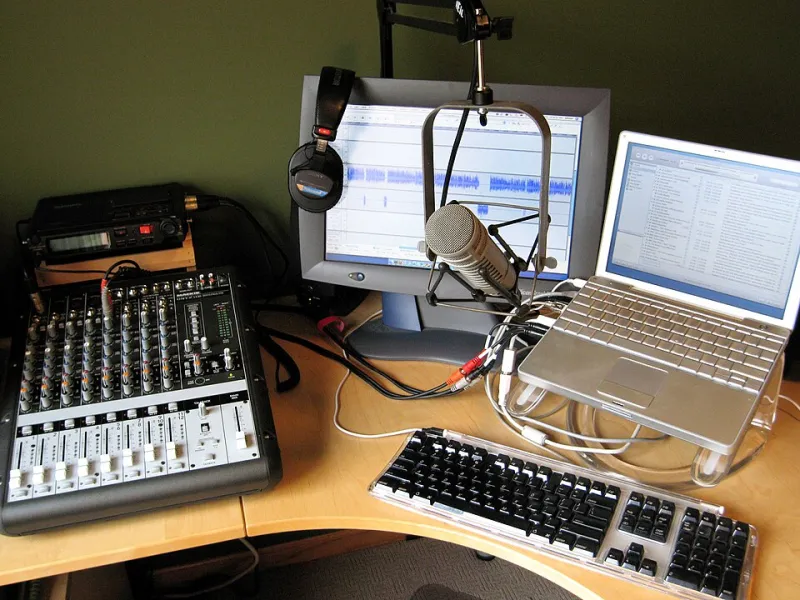
Photo: Tim Wilson, CC BY 2.0, via Wikimedia Commons
Let's be honest about something. The content experience most of us live inside right now is extraordinarily comfortable and almost completely hollow. Your social feeds know your politics, your humor, your grievances. Your streaming platforms have mapped your taste down to the sub-genre. Everything is curated, smoothed out, and optimized for engagement.
And yet — talk radio is growing. Podcast networks are pulling in record audiences. People are sitting in their cars past their destinations just to finish a conversation they started on the commute in.
That's not a coincidence. That's a correction.
The Algorithmic Diet and Its Side Effects
Media psychologists have been sounding this alarm for a few years now, but the data is starting to catch up with the theory. Dr. Pamela Rutledge, director of the Media Psychology Research Center, has written extensively about what she calls "algorithmic isolation" — the phenomenon where hyper-personalized content actually reduces our exposure to genuine disagreement, surprise, and the kind of friction that makes conversation meaningful.
The irony is sharp: platforms designed to keep us engaged are quietly making us less intellectually engaged. When everything confirms what we already believe, we stop the mental work that real conversation demands. We become passive consumers of our own opinions.
Talk radio — and its streaming-era descendants in the podcast world — operates on a fundamentally different logic. A good host doesn't know what you think before you call in. A panel debate doesn't resolve neatly into a shareable graphic. Things go sideways. People change their minds on air. Someone says something genuinely surprising.
That's not a bug. That's the entire product.
What Listeners Are Actually Saying
We asked our All Talk Radio community a straightforward question: why do you choose talk over music, curated playlists, or social video? The answers were remarkably consistent across age groups and regions.
"I feel like I'm in the room," said Marcus, a 34-year-old logistics manager from Columbus, Ohio. "With a playlist, I'm just consuming. With a talk show, I'm actually thinking."
That sense of presence — of being a participant in something rather than a recipient — came up over and over. Sandra, a retired teacher from outside Nashville, put it differently: "I trust the voice. I don't always agree with it, but I trust that it's a real person having a real reaction. You can't fake that for three hours a day."
That word trust is doing a lot of heavy lifting in this conversation, and not by accident.
The Trust Deficit and the Talk Radio Advantage
American trust in media institutions has been in freefall for roughly two decades. According to Gallup polling, confidence in mass media hit historic lows in the early 2020s, with large swaths of the population expressing skepticism toward both traditional broadcast news and social platforms.
But here's the nuance that often gets missed in that story: the distrust isn't evenly distributed. People are skeptical of institutions and platforms — but they maintain meaningful trust in specific voices they've chosen to follow. The relationship is personal rather than institutional.
That's the structural advantage talk radio has always had, and it's the reason the format is thriving while legacy media continues to struggle. When you listen to a host you've followed for years, you're not trusting a network or a brand. You're trusting a person — their judgment, their character, their consistency. That's a fundamentally different and more durable kind of loyalty.
Why Unscripted Still Wins
There's a growing body of research suggesting that audiences are becoming increasingly sophisticated at detecting inauthenticity — and increasingly impatient with it. The rise of AI-generated content has, somewhat paradoxically, made genuine human spontaneity more valuable, not less.
When a host stumbles over a word, pauses to reconsider a position, or laughs at something they didn't expect — those micro-moments of humanness are now a differentiator. They signal something that no language model can replicate: actual experience, actual uncertainty, actual stakes.
Dr. Sherry Turkle at MIT has argued for years that we've developed a hunger for what she calls "full presence" — genuine, unmediated human attention and reaction. Algorithmic content, no matter how well-targeted, can't provide that. A call-in show can. A two-hour interview where the host visibly doesn't know where the conversation is going can.
At All Talk Radio, this is the thesis we operate from every day. Real voices. Real conversations. Always on. It's not a tagline — it's a response to a genuine cultural need.
The Streaming Pivot That Changed Everything
The other piece of this story is distribution. For most of its history, talk radio was constrained by geography and the FM/AM dial. Your options were whatever stations reached your car antenna. That limitation kept the format from reaching its natural audience ceiling.
Streaming changed that equation completely. A political commentary podcast from Austin can reach a listener in rural Maine. A sports talk show launched by a former ESPN host can build a national audience without a single terrestrial affiliate. The conversation is no longer local — it's wherever the listener happens to be.
And listeners are finding these shows in numbers that would have seemed impossible ten years ago. The Interactive Advertising Bureau reported podcast ad revenues surpassing $2 billion annually, with talk and news formats leading growth. That's not a niche hobby metric. That's a mainstream media category.
The Conversation America Needed
Step back from the data for a second and consider the cultural context. The United States has spent the better part of a decade in a state of profound conversational breakdown — politically, socially, generationally. The tools we built for connection have often accelerated disconnection. The spaces designed for debate have often calcified into echo chambers.
Talk radio, at its best, has always been the antidote to that. Not because it's ideologically neutral — it often isn't — but because it's live, present, and responsive. The host hears the pushback. The caller challenges the premise. The conversation moves.
That's what Americans are craving right now. Not agreement. Not validation. Just the experience of being in a real conversation with real stakes, where nobody knows exactly how it ends.
The algorithm can't give you that. But we can.